Crossing to the Other Shore: A Solo Exhibition by Dixon Ngai
Artist: Dixon Ngai (林断山明) · Curator: Wong Ka Ying (黄嘉瀛)
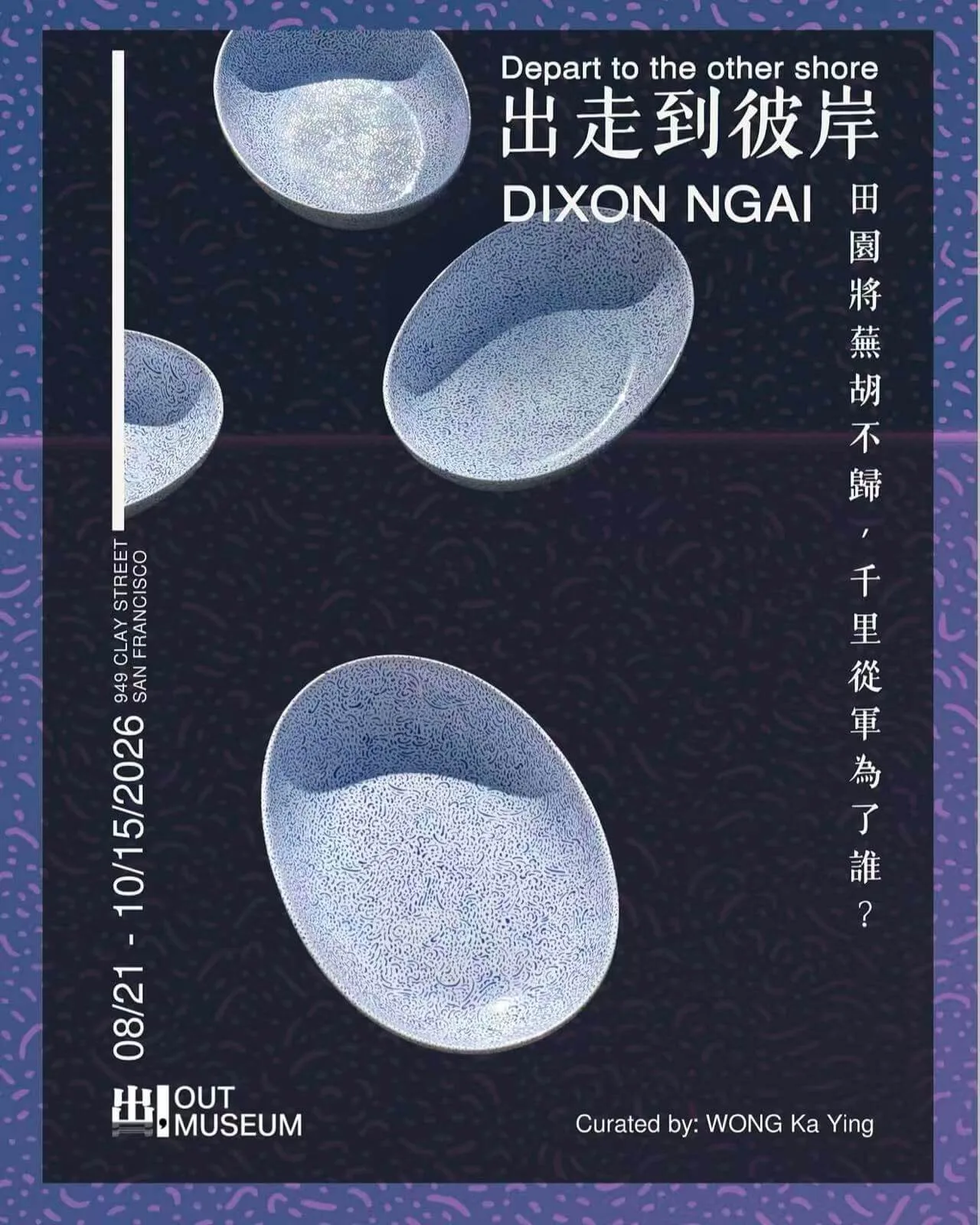
“Fields and gardens are falling to ruin — why not go home? A thousand miles off to war — and for whom?” (田园将芜胡不归,千里从军为了谁?)
The line can be traced back to the longing for home in Tao Yuanming’s “Returning Home,” and was later rewritten in the Peking opera Farewell My Concubine, in the novel of the same name and in its film adaptation, where it became a subtle tension between diaspora, duty and a homecoming endlessly deferred — a heartbreaking contradiction. In Crossing to the Other Shore, the line evokes a life of leaving home to survive and carrying one’s history across borders, only to find, on reaching the promised other shore, that “arrival” is never an end, but another beginning restarted through translation and estrangement.
For Dixon Ngai, guangcai — Canton famille-rose porcelain — is just such a medium for reaching the other shore. An export craft developed in Guangzhou, guangcai was bound up with circulation from the start: never sealed within a single cultural identity, it was portable, transformable and readily absorbed into other contexts, and so historically always faced outward to foreign markets. Dixon’s work revisits this history. Building on porcelain-painting techniques handed down from master to apprentice, he embeds the cultural symbols of contemporary Hong Kong into guangcai’s existing visual language, letting the objects speak across time without lapsing into nostalgic rhetoric. Rather than simply preserving tradition, his work tests how tradition can stay alive under the conditions of contemporary queer diaspora, cultural fragmentation and transpacific movement.
The exhibition starts from Dixon’s position as a queer Hong Konger. He is deeply rooted in Hong Kong, yet keeps his distance from the city’s imagined past. “Chinese queer nostalgia” here is not a yearning for a stable homeland, but a more unsettled and complex structure of feeling towards “home” and “roots.” Queer nostalgia does not aim to return to the past; it becomes a political tool and a means of collective healing, a way of displacing and loosening heteronormative time. By reclaiming history, Chinese queer nostalgia responds to trauma and erasure, rewriting experiences once suppressed and forgotten as narratives of survival and resilience. As the scholar José Esteban Muñoz observed, this nostalgia is a longing for what “could have been” — not to dwell in memory, but to distill the past into a path toward a more inclusive, more utopian future.
For young queer people in Hong Kong who grew up amid family pressure, political contraction and social erasure, nostalgia often arrives in fragments: films, novels, pop songs, role-play, household objects, and scenes that never truly belonged to them yet never stopped haunting them. Farewell My Concubine, like Cantonese opera, is a vital emblem for Chinese queer people: it presents performance as survival, turns desire into discipline, and forms identity through repetition under oppression. The exhibition uses this logic to show how queer memory comes not only from lived community experience but also from media images and cultural scripts.
Yet the exhibition is not confined to Hong Kong nostalgia in the narrow sense. The context of San Francisco’s Chinatown makes the question of home more complicated. Chinatown is not only a space of diaspora but also a place where the cultural memory of Hong Kong and Guangdong lives on in America, carrying histories of migration, trade and survival. For Hong Kong’s younger generation, the Hong Kong of memory is often an imagined place: a golden age made of films, music and stars, which shines precisely because it is gone. Dixon’s work asks: what does it mean for a queer Hong Kong artist to seek belonging in a place that is culturally familiar yet politically estranging? And can the nostalgic Hong Kong preserved by diasporic communities and memory truly become a home for those whose identities have always been precarious — whether in Hong Kong itself or across the wider Sinophone world?
Dixon responds through porcelain, painting, installation and performance. Lament for the Ravaged Realm (江山悲灾劫) restages The Flower Princess (帝女花) on export porcelain, re-enacting a classic Cantonese opera of loyalty and love unto death within a diasporic setting. Spray (浪花) holds the emotional residue of work made at home during the pandemic, when staying and leaving, pausing and changing seemed equally impossible to settle. Voyage Log (航海纪录) extends the gallery wall into a sequence of traces, recalling both the poems Chinese immigrants carved into the walls of Angel Island and the marking system for Hong Kong export goods. Here the marks on porcelain bases, the packing foam and the fragile rims of the vessels merge into a single visual language: breakable things wrapped up and carried off on the waves, identities placed in temporary protection, history carried along the seams of circulation and aboard ships. Crossing to the Other Shore likewise reworks the form of the vessel, reimagining it as a small boat — a journey paused, an arrival held in suspension. These works remind us that migration does not end on landing; it continues in a grammar of hovering, delay and change of course.
Dixon’s Cantonese opera performance sharpens the proposition further: with its hard-won stagecraft, gendered role types and formal ambiguity, it offers a bodily language capacious enough for fluid identities. In song and gesture, characters are summoned and voice and body transform at will. Performance becomes one of the materials of the work, linking the queer subject to historical forms and turning emotional inheritance into a practice of one’s own.
Crossing to the Other Shore tells of a journey without end, considering how export porcelain, Chinese queer nostalgia and diasporic feeling overlap to form the present experience of living in diaspora. The other shore is not the destination where the journey ends. It is the distance made visible through a telescope; the place where nostalgia is forged into form; and the elsewhere where the ruptures between home, history and self can be briefly held on porcelain’s fragile, reflective surface.
Artist
Dixon Ngai (林断山明, b. 1995) lives and works between Hong Kong and the San Francisco Bay Area. A graduate of Environment and Interior Design at The Hong Kong Polytechnic University, he works across objects, painting and spatial design, with a deep interest in the history of Chinese export porcelain and its ties to stories of Chinese migration. Working with the Tao Fong Shan Christian Centre in Hong Kong, he coordinates the conservation and production of guangcai porcelain, exploring the links between Hong Kong export porcelain and the journeys of travelers. He now draws constant inspiration from the porcelain shops of San Francisco’s Chinatown, where a core part of his practice has developed.
Curator
Wong Ka Ying (KY) is a Hong Kong artist, curator and writer, and a PhD candidate in Cultural Studies at The Chinese University of Hong Kong. She was recently selected for the 2026 International Researcher Residency at the National Museum of Modern and Contemporary Art, Korea (MMCA) in Seoul, the de Appel Curatorial Programme 2026–2027 in the Netherlands, and the eighth edition of Unschool of Curating in Romania, “Repair as Method.”
Wong’s research focuses on socially engaged art, curatorial practice beyond the gallery, and the intersections of justice, community, memory, archives and cultural production. She has long worked with groups advocating for gender equality, queer identities, survivors of sexual violence, disability rights, migrant communities and labor rights. Her curatorial practice explores how art can open up alternative models for redistributing power, resist cultural homogenization, and nurture diverse forms of collective imagination and action, as well as questions of identity for Asian migrants and migrant workers in transnational and diasporic contexts.