《出走到彼岸》— 林斷山明最新個展
Solo exhibition: Depart to the other shore
OUT Museum 榮幸推出藝術家 林斷山明(Dixon Ngai)最新個展《出走到彼岸》,由黃嘉瀛(KY)策展
OUT Museum is pleased to present Depart to the other shore, a solo exhibition by Dixon Ngai, curated by Wong Ka Ying (KY).
《出走到彼岸》— 林斷山明最新個展
Solo exhibition: Depart to the other shore
OUT|出|博物館呈現
Presented by OUT|出|Museum
開幕Opening Reception: Friday, August 21st 5:00 - 8:00pm
日期Date: 21/08/2026 - 15/10/2026
時間Opening Hours: Every Thursday to Sunday, 12:00 - 4:30pm
地址 Address: Out Museum, 949 Clay st, San Francisco
開幕Opening Reception: Friday, August 21st 5:00 - 8:00pm
日期Date: 21/08/2026 - 15/10/2026
時間Opening Hours: Every Thursdays to Saturdays, 12:00 - 4:30pm
地址 Address: Out Museum, 949 Clay st, San Francisco
藝術家/Artist:林斷山明(Dixon Ngai)
策展人/Curator:黃嘉瀛(Wong Ka Ying KY)
藝術家/Artist:林斷山明(Dixon Ngai)
策展人/Curator:黃嘉瀛(Wong Ka Ying KY)

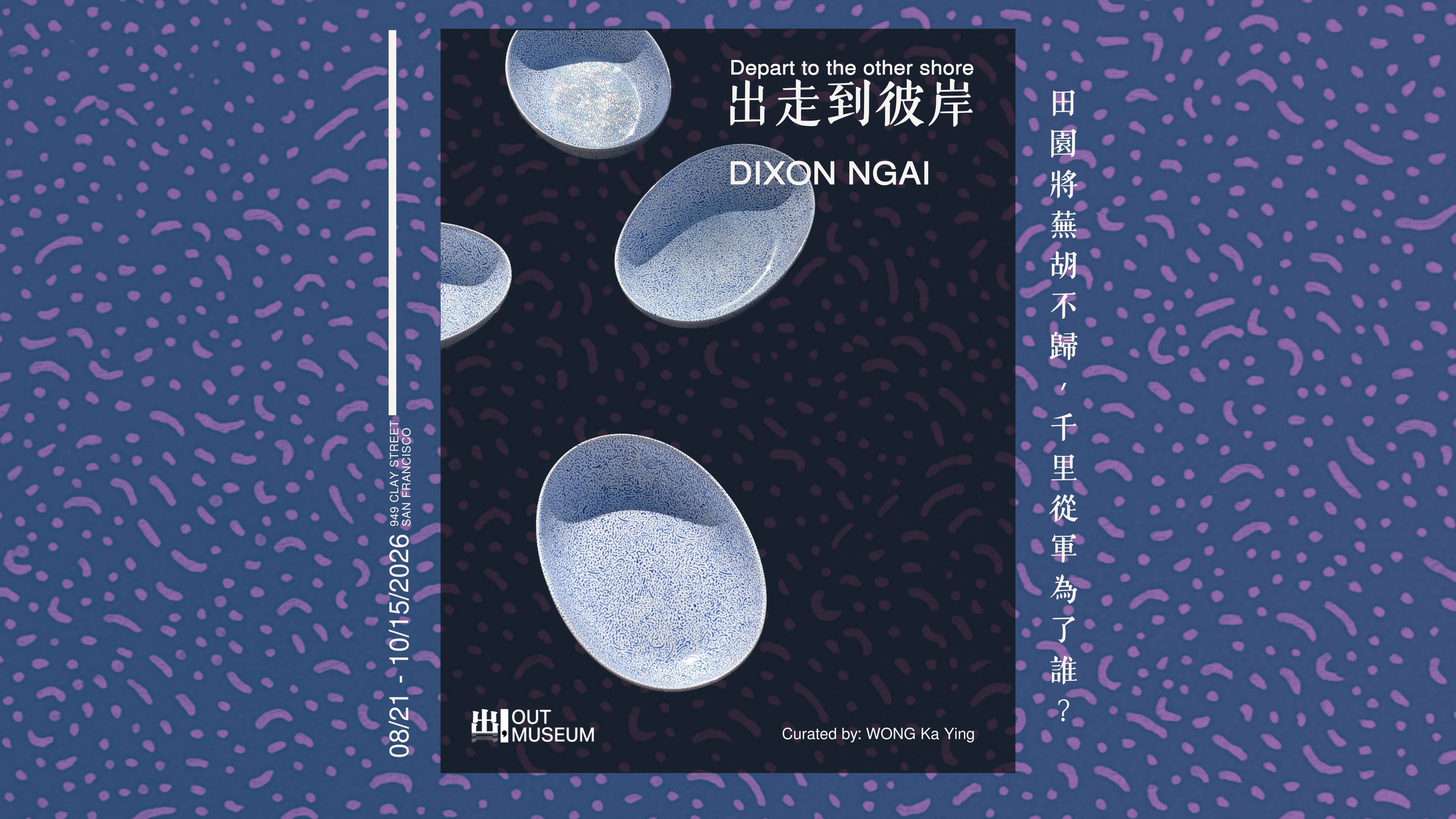
「田園將蕪胡不歸,千里從軍為了誰?」
這句詩最初可追溯至陶淵明《歸去來兮辭》中的返鄉之思,後來又經京劇《霸王別姬》及其同名小說和改編電影重新書寫,化為離散、責任與歸返延宕之間的幽微張力,其所承載的,是一種令人心碎的矛盾。在《出走到彼岸》展覽中,這句話展示了為了生存而離家,將自身的歷史攜帶越界的生命狀態,並在抵達被許諾的彼岸之後發現,所謂的「抵達」從來都不是終點,而是另一個由翻譯和疏離重啟的開端。
對林斷山明(Dixon Ngai)而言,廣彩正是這樣一種通往彼岸的媒介。廣彩作為廣州發展出的出口工藝,從誕生之初便與流通相連;它從未被封存於單一文化身份之中,反而因其可移動、可轉化、可被不同語境吸納的特質,而在歷史上持續面向外部市場。Dixon的創作重新審視了這段歷史,他以師徒制傳承下來的瓷畫技藝為基礎,將當代香港的文化符號嵌入廣彩的既有語言之中,使器物得以跨越時間而發聲,卻不淪為懷舊的修辭。他的作品非單純為保存傳統,更多是在當代酷兒離散、文化碎裂與跨太平洋流動的條件下,去測試傳統如何仍能保持活力。
這次展覽從Dixon的香港酷兒身位展開。他既深植香港,又與這座城市被想像中的過去保持距離。所謂「華人酷兒鄉愁」,在此並非對穩定家園的嚮望,而是一種更為不安、亦更為複雜,對「家」與「根」的情感結構。酷兒的鄉愁不為返回過去,卻化身為政治性的工具和集體療癒的方式,也是一種對異性戀時間秩序的挪移與鬆動。透過奪回歷史,華人酷兒鄉愁成為面對創傷與抹除的回應,把那些曾被壓抑、被遺忘的經驗,重新書寫為生存與韌性的敘事。正如學者 José Esteban Muñoz 所指出,這種鄉愁是對「本可如此」的渴望——不求停留於回憶,但求將過去提煉為通往更具包容性、也更具烏托邦想像的未來。
對於在家庭壓力、政治收縮與社會抹消之中成長的香港年輕酷兒而言,鄉愁往往以碎片形態出現:電影、小說、流行曲、角色扮演、家中器物,以及那些從未真正屬於自己、卻始終縈繞不去的場景。《霸王別姬》,或粵劇表演,是華人酷兒極其重要的借代符號,它將表演呈現為生存,把欲望化作訓練,並在壓迫之下以重複構成身份。展覽正是借由這種邏輯,揭示酷兒記憶如何不只來自真實社群的經驗,也同時由媒介影像與文化腳本共同塑造。
然而,展覽並不侷限於狹義的香港鄉愁。舊金山唐人街的語境,使「家」的問題變得更為複雜。唐人街不僅是離散的空間,也是香港與廣東文化記憶在美國的存續地,承載著移民、商貿與求存的歷史。對香港年輕一代而言,記憶中的香港往往是一個想像之地:一個由電影、音樂與明星構成的黃金年代,而這個年代之所以閃耀,恰恰因為它已經遠去。Dixon 的作品追問:一位香港酷兒藝術家,若在一個文化上熟悉、政治上卻又充滿疏離感的地方尋找歸屬,究竟意味著甚麼?而被離散社群與記憶共同保存下來的懷舊香港,是否真能成為那些身份始終脆弱之人的家園——無論是在香港本地,還是在更廣義的華語世界之中?
Dixon的創作以瓷器、繪畫、裝置與表演回應思考。《江山悲災劫》以出口瓷重新演繹《帝女花》,將一齣關於忠義與殉情的經典粵劇,置入離散情境中的再扮演。《浪花》保存了疫情期間居家創作的情緒殘留:留與走、停與變,彷彿都同樣難以安放。《航海紀錄》則把展牆延展為一片序列化的痕跡,既呼應天使島華人刻詩的歷史,也喚起香港製品出口時的標記制度。在這裡,瓷器底部的款識、包裝的泡棉、器物的脆弱邊緣,都匯成同一種視覺語言:易碎之物被包裹著隨海浪遠行,身份被安置於暫時的保護之中,歷史則沿著流通的縫隙和船隻被攜帶下來。《出走到彼岸》亦以此重述器物的形態,把器皿重新想像為一艘小船,一段被暫停的航程,一次懸置中的抵達。作品提醒我們,遷移並不會在落地後終結;它仍持續於懸停、延遲與轉向的語法之中。
Dixon的粵劇表演以練就的身段、性別分工與形式上的曖昧性,提供了一種足以容納流動身份的身體語言,進一步銳化命題。在唱與演之中,角色被召喚、聲音與身體隨心可變。表演成為了作品本身的材料之一,將酷兒主體與歷史形式相連,也將情感繼承轉化為自身演練。
《出走到彼岸》講述一段沒有終點的旅途,思考出口瓷器、華人酷兒鄉愁與離散情感,如何交疊成離散海外的當下感受。彼岸不是旅程終結的目的地;彼岸是望遠鏡中的可視遠方,是鄉愁被鍛造成形式的所在,也是家園、歷史與自我之間的破裂,得以在瓷器脆弱而反光的表面上,被短暫承接起來的他方。
藝術家
林斷山明(Dixon Ngai,1995年出生)現於香港與舊金山灣區生活及工作。他畢業於香港理工大學環境及室內設計學系,創作領域橫跨器物、繪畫與空間設計,並深切關注中國外銷瓷器的歷史及其與華人移民故事的連結。他與香港道風山基督教叢林合作,負責協調廣彩瓷器的保育與生產工作,藉此探索香港外銷瓷器與旅人旅程之間的關聯。目前,他從舊金山唐人街的瓷器店中汲取源源不絕的靈感,並在當地發展出其創作實踐的核心部分。
策展人
黃嘉瀛(KY)是香港的藝術家、策展人、作者,現為香港中文大學文化研究學系博士候選人。她近期獲選參與韓國首爾國立現代美術館(MMCA)國際研究員駐留計劃 2026、荷蘭de Appel 策展課程 2026–2027,以及羅馬尼亞Unschool of Curating 第八期:以修復為方法。
黃氏的研究聚焦於社會參與式藝術、畫廊以外的策展實踐,以及公義、社群、記憶、檔案與文化生產之間的交錯關係。她長期與性別平權、酷兒身份、性暴力倖存者、身障者權益、移民社群及勞工權益等團體合作。她的策展實踐探索藝術如何開創另類的權力再分配模式、抵抗文化同質化、培養多元的集體想像與行動形式,以及亞洲移民與移工在跨國與離散脈絡下的身份議題。
“What reason is there not to return, when the fields are going to waste?
For whom do I travel a thousand miles?”
This line of wrenching ambivalence, can be traced back to Tao Yuanming's longing for home in Return, and was later rewritten through the Peking opera Farewell My Concubine, its novel of the same name, and the film adaptation, becoming a subtle tension between diaspora, duty, and deferred return; what it carries is a heartbreaking sense of contradiction. In Depart to the Other Shore, this line becomes a condition of life: leaving home in order to survive, carrying one's history across borders, and discovering that the promised shore is never simply an arrival, but a beginning of translation, estrangement, and becoming.
For Dixon Ngai (Lam Duen Shan Ming), guangcai porcelain is precisely such a medium of passage. Historically developed in Guangzhou as an export craft, guangcai was made for circulation. It was never sealed inside a single cultural identity; rather, it was designed to move, to adapt, and to seduce foreign markets with hybrid surfaces. Ngai's practice reactivates this history for the present. Working from an apprenticeship-based mastery of porcelain painting, he inserts contemporary symbols of Hong Kong into the inherited language of Canton porcelain, allowing the object to speak across time without being trapped by nostalgia. His work does not simply preserve tradition; it tests how tradition might remain alive under contemporary conditions of queer displacement, cultural fragmentation, and transpacific mobility.
The exhibition unfolds from Ngai's position as a Hong Kong queer artist who is both attached to and distanced from the city's imagined past. Chinese queer nostalgia here is rather a more unstable and ambivalent structure of feeling for 'home' and 'root'. Far from a simple desire to return to the past, Chinese queer nostalgia serves as a tool for political empowerment, collective healing, and subverting heteronormative timelines. By reclaiming history, it acts as a coping mechanism and an active rewriting of traumatic or erased histories into narratives of survival and resilience. Theorist José Esteban Muñoz described it as a longing for what might have been—distilling the past to imagine more inclusive, utopian futures.
For young Hong Kong queer subjects shaped by family pressure, political contraction, and social erasure, nostalgia often takes the form of fragments: films, pop songs, role-play, household objects, and scenes that never fully belonged to them yet continue to haunt them. The Chinese opera in Farewell My Concubine occupies a central place in the Chinese Queer's emotional landscape. It stages performance as survival, desire as discipline, and identity as repetition under pressure. The exhibition draws from this logic to show how queer memory is made not only through lived community, but also through mediated images and inherited cultural scripts.
At the same time, the exhibition refuses a narrow Hong Kong nostalgia. The Chinatown context in San Francisco complicates the question of home. Chinatown is more than a site of diaspora, it is also a repository of Hong Kong and Cantonese cultural memory in the United States, shaped by migration, commerce, and survival. For Hong Kong younger generations, however, the city preserved in memory is often an imagined one: an era of cinema, music, and stars that appears golden precisely because it has already receded. Ngai's work enters this tension. He asks what it means for a Hong Kong queer artist to seek belonging in a place that feels culturally familiar yet politically and emotionally dislocated. It also asks whether the nostalgic Hong Kong cherished by diaspora and by memory can ever serve as a home for those whose identities remain precarious in both Hong Kong and the wider Sinosphere.
Ngai's art articulates this question through porcelain, painting, installation, and performance. 江山悲災劫 Catastrophe has befallen the empire re-reads The Flower Princess through export porcelain, placing a canonical opera of loyalty and sacrifice into the register of diasporic re-enactment. Flowers in the Wave holds the emotional residue of pandemic isolation and unsettled time, where the desire to remain and the necessity to depart seem equally unresolvable. Ship's log extends the exhibition wall into a field of serial marks, recalling Angel Island inscriptions while evoking the historic marking of Hong Kong-made goods for export. Here, porcelain's underside, its base mark, and its packaging foam all become part of the same visual language: fragile objects wrapped for transit, identities cushioned yet never secure, histories carried in the seams of circulation. Depart to the other shore similarly reframes the vessel as a small ship, a paused trajectory, a suspended arrival. The work suggests that migration does not end with landing; it continues in the unstable grammar of suspension, delay, and redirected desire.
Chinese Opera, with its codified gestures, gendered roles, and formal ambiguity, offers a vocabulary for bodies that do not fit fixed social scripts. In singing and staging Chinese opera, Lam's extended performance activates the fluidity of role, voice, and embodiment. He treats performance not as an accessory to the exhibition, but as another material in the work: one that links queer subjectivity to historical form, and emotional inheritance to embodied rehearsal.
This exhibition is about a journey without resolution. It considers how export porcelain, Chinese queer nostalgia, and diasporic feeling intersect to shape the present condition of life abroad. The "other shore" is not a destination that ends the journey; it is the distant horizon made visible, the place where longing is forged into form, and the elsewhere in which the ruptures between home, history, and self can be held—however briefly—within the fragile, reflective surface of porcelain.
Artist
Dixon Ngai (1995) is a Hong Kong and San Francisco Bay Area- based artist and designer who graduated from the Hong Kong Polytechnic University, Department of Environmental and Interior Design. His work spans objects, painting, and spatial design, with a deep focus on the history of Chinese export porcelain and its connections to the story of Chinese immigration. He collaborates with the Tao Fong Shan Christian Centre in Hong Kong, coordinating the preservation and production of Canton porcelain. Exploring the connections between Hong Kong export porcelain and traveler's journey. He currently draw ongoing inspiration from the porcelain shops in SF Chinatown, where he has developed key parts of his practice
Curator
Wong Ka Ying is a Hong Kong artist, curator, writer, and PhD candidate in Cultural Studies at the Chinese University of Hong Kong. She was recently selected for the MMCA International Researcher Residency Program 2026, the de Appel Curatorial Programme 2026–2027, and The Unschool of Curating #8: Repair as Method.
Wong's research focuses on socially engaged art, curatorial practices beyond galleries, and the intersections of justice, community, memory, archives, and cultural production. She is a long term partner with gender equality, queer identity, sexual violence survivors, disability rights, migrant communities and labour rights groups. Her curatorial practice explores how art can generate alternative modes of power redistribution, resist cultural homogenisation, cultivate plural forms of collective imagination and action and the identities of Asian migrants and migrant workers across transnational and diasporic contexts.
「田園將蕪胡不歸,千里從軍為了誰?」
這句詩最初可追溯至陶淵明《歸去來兮辭》中的返鄉之思,後來又經京劇《霸王別姬》及其同名小說和改編電影重新書寫,化為離散、責任與歸返延宕之間的幽微張力,其所承載的,是一種令人心碎的矛盾。在《出走到彼岸》展覽中,這句話展示了為了生存而離家,將自身的歷史攜帶越界的生命狀態,並在抵達被許諾的彼岸之後發現,所謂的「抵達」從來都不是終點,而是另一個由翻譯和疏離重啟的開端。
對林斷山明(Dixon Ngai)而言,廣彩正是這樣一種通往彼岸的媒介。廣彩作為廣州發展出的出口工藝,從誕生之初便與流通相連;它從未被封存於單一文化身份之中,反而因其可移動、可轉化、可被不同語境吸納的特質,而在歷史上持續面向外部市場。Dixon的創作重新審視了這段歷史,他以師徒制傳承下來的瓷畫技藝為基礎,將當代香港的文化符號嵌入廣彩的既有語言之中,使器物得以跨越時間而發聲,卻不淪為懷舊的修辭。他的作品非單純為保存傳統,更多是在當代酷兒離散、文化碎裂與跨太平洋流動的條件下,去測試傳統如何仍能保持活力。
這次展覽從Dixon的香港酷兒身位展開。他既深植香港,又與這座城市被想像中的過去保持距離。所謂「華人酷兒鄉愁」,在此並非對穩定家園的嚮望,而是一種更為不安、亦更為複雜,對「家」與「根」的情感結構。酷兒的鄉愁不為返回過去,卻化身為政治性的工具和集體療癒的方式,也是一種對異性戀時間秩序的挪移與鬆動。透過奪回歷史,華人酷兒鄉愁成為面對創傷與抹除的回應,把那些曾被壓抑、被遺忘的經驗,重新書寫為生存與韌性的敘事。正如學者 José Esteban Muñoz 所指出,這種鄉愁是對「本可如此」的渴望——不求停留於回憶,但求將過去提煉為通往更具包容性、也更具烏托邦想像的未來。
對於在家庭壓力、政治收縮與社會抹消之中成長的香港年輕酷兒而言,鄉愁往往以碎片形態出現:電影、小說、流行曲、角色扮演、家中器物,以及那些從未真正屬於自己、卻始終縈繞不去的場景。《霸王別姬》,或粵劇表演,是華人酷兒極其重要的借代符號,它將表演呈現為生存,把欲望化作訓練,並在壓迫之下以重複構成身份。展覽正是借由這種邏輯,揭示酷兒記憶如何不只來自真實社群的經驗,也同時由媒介影像與文化腳本共同塑造。
然而,展覽並不侷限於狹義的香港鄉愁。舊金山唐人街的語境,使「家」的問題變得更為複雜。唐人街不僅是離散的空間,也是香港與廣東文化記憶在美國的存續地,承載著移民、商貿與求存的歷史。對香港年輕一代而言,記憶中的香港往往是一個想像之地:一個由電影、音樂與明星構成的黃金年代,而這個年代之所以閃耀,恰恰因為它已經遠去。Dixon 的作品追問:一位香港酷兒藝術家,若在一個文化上熟悉、政治上卻又充滿疏離感的地方尋找歸屬,究竟意味著甚麼?而被離散社群與記憶共同保存下來的懷舊香港,是否真能成為那些身份始終脆弱之人的家園——無論是在香港本地,還是在更廣義的華語世界之中?
Dixon的創作以瓷器、繪畫、裝置與表演回應思考。《江山悲災劫》以出口瓷重新演繹《帝女花》,將一齣關於忠義與殉情的經典粵劇,置入離散情境中的再扮演。《浪花》保存了疫情期間居家創作的情緒殘留:留與走、停與變,彷彿都同樣難以安放。《航海紀錄》則把展牆延展為一片序列化的痕跡,既呼應天使島華人刻詩的歷史,也喚起香港製品出口時的標記制度。在這裡,瓷器底部的款識、包裝的泡棉、器物的脆弱邊緣,都匯成同一種視覺語言:易碎之物被包裹著隨海浪遠行,身份被安置於暫時的保護之中,歷史則沿著流通的縫隙和船隻被攜帶下來。《出走到彼岸》亦以此重述器物的形態,把器皿重新想像為一艘小船,一段被暫停的航程,一次懸置中的抵達。作品提醒我們,遷移並不會在落地後終結;它仍持續於懸停、延遲與轉向的語法之中。
Dixon的粵劇表演以練就的身段、性別分工與形式上的曖昧性,提供了一種足以容納流動身份的身體語言,進一步銳化命題。在唱與演之中,角色被召喚、聲音與身體隨心可變。表演成為了作品本身的材料之一,將酷兒主體與歷史形式相連,也將情感繼承轉化為自身演練。
《出走到彼岸》講述一段沒有終點的旅途,思考出口瓷器、華人酷兒鄉愁與離散情感,如何交疊成離散海外的當下感受。彼岸不是旅程終結的目的地;彼岸是望遠鏡中的可視遠方,是鄉愁被鍛造成形式的所在,也是家園、歷史與自我之間的破裂,得以在瓷器脆弱而反光的表面上,被短暫承接起來的他方。
藝術家
林斷山明(Dixon Ngai,1995年出生)現於香港與舊金山灣區生活及工作。他畢業於香港理工大學環境及室內設計學系,創作領域橫跨器物、繪畫與空間設計,並深切關注中國外銷瓷器的歷史及其與華人移民故事的連結。他與香港道風山基督教叢林合作,負責協調廣彩瓷器的保育與生產工作,藉此探索香港外銷瓷器與旅人旅程之間的關聯。目前,他從舊金山唐人街的瓷器店中汲取源源不絕的靈感,並在當地發展出其創作實踐的核心部分。
策展人
黃嘉瀛(KY)是香港的藝術家、策展人、作者,現為香港中文大學文化研究學系博士候選人。她近期獲選參與韓國首爾國立現代美術館(MMCA)國際研究員駐留計劃 2026、荷蘭de Appel 策展課程 2026–2027,以及羅馬尼亞Unschool of Curating 第八期:以修復為方法。
黃氏的研究聚焦於社會參與式藝術、畫廊以外的策展實踐,以及公義、社群、記憶、檔案與文化生產之間的交錯關係。她長期與性別平權、酷兒身份、性暴力倖存者、身障者權益、移民社群及勞工權益等團體合作。她的策展實踐探索藝術如何開創另類的權力再分配模式、抵抗文化同質化、培養多元的集體想像與行動形式,以及亞洲移民與移工在跨國與離散脈絡下的身份議題。
“What reason is there not to return, when the fields are going to waste?
For whom do I travel a thousand miles?”
This line of wrenching ambivalence, can be traced back to Tao Yuanming's longing for home in Return, and was later rewritten through the Peking opera Farewell My Concubine, its novel of the same name, and the film adaptation, becoming a subtle tension between diaspora, duty, and deferred return; what it carries is a heartbreaking sense of contradiction. In Depart to the Other Shore, this line becomes a condition of life: leaving home in order to survive, carrying one's history across borders, and discovering that the promised shore is never simply an arrival, but a beginning of translation, estrangement, and becoming.
For Dixon Ngai (Lam Duen Shan Ming), guangcai porcelain is precisely such a medium of passage. Historically developed in Guangzhou as an export craft, guangcai was made for circulation. It was never sealed inside a single cultural identity; rather, it was designed to move, to adapt, and to seduce foreign markets with hybrid surfaces. Ngai's practice reactivates this history for the present. Working from an apprenticeship-based mastery of porcelain painting, he inserts contemporary symbols of Hong Kong into the inherited language of Canton porcelain, allowing the object to speak across time without being trapped by nostalgia. His work does not simply preserve tradition; it tests how tradition might remain alive under contemporary conditions of queer displacement, cultural fragmentation, and transpacific mobility.
The exhibition unfolds from Ngai's position as a Hong Kong queer artist who is both attached to and distanced from the city's imagined past. Chinese queer nostalgia here is rather a more unstable and ambivalent structure of feeling for 'home' and 'root'. Far from a simple desire to return to the past, Chinese queer nostalgia serves as a tool for political empowerment, collective healing, and subverting heteronormative timelines. By reclaiming history, it acts as a coping mechanism and an active rewriting of traumatic or erased histories into narratives of survival and resilience. Theorist José Esteban Muñoz described it as a longing for what might have been—distilling the past to imagine more inclusive, utopian futures.
For young Hong Kong queer subjects shaped by family pressure, political contraction, and social erasure, nostalgia often takes the form of fragments: films, pop songs, role-play, household objects, and scenes that never fully belonged to them yet continue to haunt them. The Chinese opera in Farewell My Concubine occupies a central place in the Chinese Queer's emotional landscape. It stages performance as survival, desire as discipline, and identity as repetition under pressure. The exhibition draws from this logic to show how queer memory is made not only through lived community, but also through mediated images and inherited cultural scripts.
At the same time, the exhibition refuses a narrow Hong Kong nostalgia. The Chinatown context in San Francisco complicates the question of home. Chinatown is more than a site of diaspora, it is also a repository of Hong Kong and Cantonese cultural memory in the United States, shaped by migration, commerce, and survival. For Hong Kong younger generations, however, the city preserved in memory is often an imagined one: an era of cinema, music, and stars that appears golden precisely because it has already receded. Ngai's work enters this tension. He asks what it means for a Hong Kong queer artist to seek belonging in a place that feels culturally familiar yet politically and emotionally dislocated. It also asks whether the nostalgic Hong Kong cherished by diaspora and by memory can ever serve as a home for those whose identities remain precarious in both Hong Kong and the wider Sinosphere.
Ngai's art articulates this question through porcelain, painting, installation, and performance. 江山悲災劫 Catastrophe has befallen the empire re-reads The Flower Princess through export porcelain, placing a canonical opera of loyalty and sacrifice into the register of diasporic re-enactment. Flowers in the Wave holds the emotional residue of pandemic isolation and unsettled time, where the desire to remain and the necessity to depart seem equally unresolvable. Ship's log extends the exhibition wall into a field of serial marks, recalling Angel Island inscriptions while evoking the historic marking of Hong Kong-made goods for export. Here, porcelain's underside, its base mark, and its packaging foam all become part of the same visual language: fragile objects wrapped for transit, identities cushioned yet never secure, histories carried in the seams of circulation. Depart to the other shore similarly reframes the vessel as a small ship, a paused trajectory, a suspended arrival. The work suggests that migration does not end with landing; it continues in the unstable grammar of suspension, delay, and redirected desire.
Chinese Opera, with its codified gestures, gendered roles, and formal ambiguity, offers a vocabulary for bodies that do not fit fixed social scripts. In singing and staging Chinese opera, Lam's extended performance activates the fluidity of role, voice, and embodiment. He treats performance not as an accessory to the exhibition, but as another material in the work: one that links queer subjectivity to historical form, and emotional inheritance to embodied rehearsal.
This exhibition is about a journey without resolution. It considers how export porcelain, Chinese queer nostalgia, and diasporic feeling intersect to shape the present condition of life abroad. The "other shore" is not a destination that ends the journey; it is the distant horizon made visible, the place where longing is forged into form, and the elsewhere in which the ruptures between home, history, and self can be held—however briefly—within the fragile, reflective surface of porcelain.
Artist
Dixon Ngai (1995) is a Hong Kong and San Francisco Bay Area- based artist and designer who graduated from the Hong Kong Polytechnic University, Department of Environmental and Interior Design. His work spans objects, painting, and spatial design, with a deep focus on the history of Chinese export porcelain and its connections to the story of Chinese immigration. He collaborates with the Tao Fong Shan Christian Centre in Hong Kong, coordinating the preservation and production of Canton porcelain. Exploring the connections between Hong Kong export porcelain and traveler's journey. He currently draw ongoing inspiration from the porcelain shops in SF Chinatown, where he has developed key parts of his practice
Curator
Wong Ka Ying is a Hong Kong artist, curator, writer, and PhD candidate in Cultural Studies at the Chinese University of Hong Kong. She was recently selected for the MMCA International Researcher Residency Program 2026, the de Appel Curatorial Programme 2026–2027, and The Unschool of Curating #8: Repair as Method.
Wong's research focuses on socially engaged art, curatorial practices beyond galleries, and the intersections of justice, community, memory, archives, and cultural production. She is a long term partner with gender equality, queer identity, sexual violence survivors, disability rights, migrant communities and labour rights groups. Her curatorial practice explores how art can generate alternative modes of power redistribution, resist cultural homogenisation, cultivate plural forms of collective imagination and action and the identities of Asian migrants and migrant workers across transnational and diasporic contexts.